1. Overview of Consular Certification and Consular Legalization
Consular certification in South Korea refers to the process in which Korean authorities (typically the Consular Affairs Bureau – Ministry of Foreign Affairs of South Korea) verify and authenticate Korean-issued documents.
Consular legalization in South Korea is the process in which relevant Korean authorities certify the legal validity of Vietnamese-issued documents so they can be officially recognized and used in South Korea.
In general, documents issued in South Korea must be certified by the Korean Ministry of Foreign Affairs before being used in Vietnam, and likewise, documents from Vietnam must be legalized before they can be used in South Korea.
Location for Consular Certification:
The Office for Document Legalization under the Korea Office of Overseas Koreans (재외동포청)
Address: 15th Floor, Twin Tree Tower A, 6 Yulgok-ro, Jongno-gu, Seoul, South Korea.

*The Office for Document Legalization operates under the Korea Office of Overseas Koreans (재외동포청).
2. Procedures for Consular Legalization in South Korea
Below is the step-by-step process for the consular legalization of documents between Vietnam and South Korea.
|
Process for Consular Legalization of Korean Documents for Use in Vietnam
|
Process for Consular Legalization of Vietnamese Documents for Use in South Korea
|
-
Prepare all required documents
-
Book an online appointment with the Embassy of Vietnam in South Korea
-
Translate and notarize the documents that require consular legalization
-
Obtain consular certification from the Ministry of Foreign Affairs of South Korea
-
Obtain consular legalization from the Embassy of Vietnam in South Korea
|
-
Prepare all required documents
-
Translate and notarize the documents that require consular legalization
-
Obtain consular certification from the Ministry of Foreign Affairs of Vietnam
-
Obtain consular legalization from the Embassy of South Korea in Vietnam
|
3. Consular Certification Procedures
At this stage, you will need to complete all required steps in order: translation, notarization, and consular certification.
Step 1: Translate the documents into Vietnamese or English.
The average translation time is approximately 20–30 minutes, and the translation fee is 25,000 KRW per page (as of 2023). You may choose one of the following methods:
-
Ask a friend who has TOPIK level 5 or 6 to translate the documents
-
Use a professional translation service
-
Request translation through a notary office
For faster processing, it is recommended to choose option 1 or 2.

*Image of the Office for Document Legalization under the Korea Office of Overseas Koreans (재외동포청)
Step 2: Visit a notary office and obtain notarization
The second step is generally faster than the translation step, taking around 5–10 minutes.
The notarization fee is 28,000 KRW per document.
Notes:
-
If you yourself go to notarize your own documents, translation is not required. However, if someone else goes on your behalf, the documents must be translated — this is a rule of the notary office.
-
Even if the document is already in English, notarization is still required.
-
If you have TOPIK level 5 or 6, you may translate the document yourself to save translation costs.
-
Bring your printed TOPIK certificate when notarizing and sign to confirm the accuracy of the translation.
-
If a friend translates for you, they must also be present at the notary office to sign the confirmation.
-
The nearest notary/translation office is located on B1 floor, with Vietnamese staff available.
Step 3: Consular Certification (or download in here)
-
Obtain the application form from the guidance counter (or download it in advance) and fill it out.
Important: Do not take a queue ticket before completing the form — otherwise you risk losing your turn.
The form includes:
-
신청자 인적사항: Applicant’s personal information
-
신청인 성명: Name in Korean
-
신청인 영문성명: Name in English
-
주민등록번호: ID number
-
연락처: Contact number
-
주소: Permanent address
-
문서의 명칭: Name of the document requiring certification
-
제출대상 공관: Receiving authority
-
문서발급기관: Name of the issuing authority
-
Purchase a set of stamps at the last counter.
-
Return to the guidance counter, submit the completed form, and take a queue number from the machine next to Counter 1.
-
Wait for your number to be called and submit your documents.
-
Present your Alien Registration Card (ARC) for identity verification. You will then receive a pickup slip.
After approximately 30 minutes, you can return to collect your certified documents.

4. Consular Legalization
This step is carried out at the Embassy of Vietnam in South Korea.
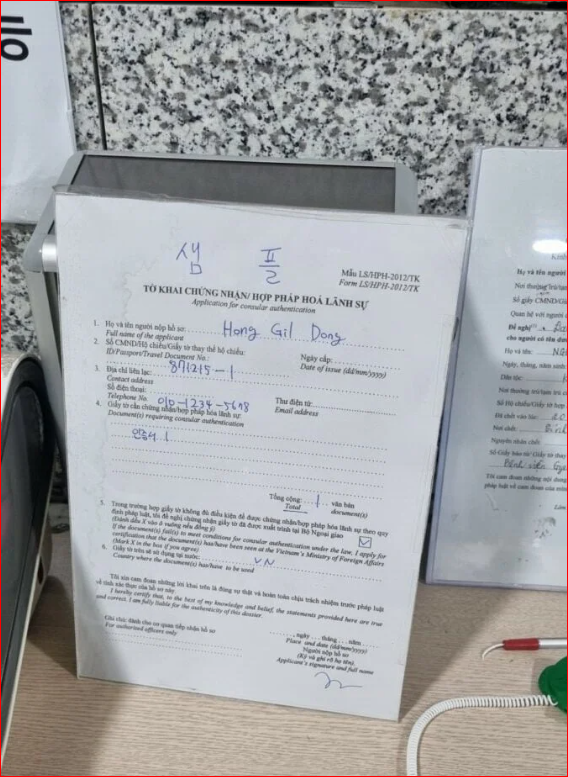
Before your visit, it is recommended to fill out the required information for the documents to be legalized using the form LS/HPH-2012/TK, then print it out in advance to save time at the embassy.
Below is the guideline on how to complete this form:
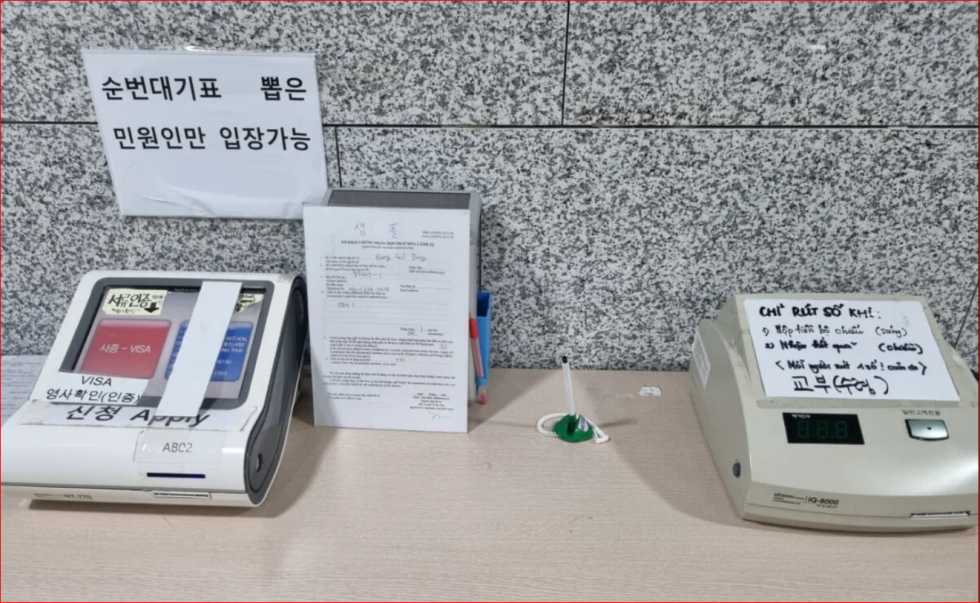
How to Get a Queue Number
When you arrive at the embassy, you will first fill out the service information slip (including your full name, phone number, passport number, and the purpose of your visit).
The staff member seated near the entrance will check your appointment and then give you a queue number. This person speaks only Korean.
If you do not book an appointment in advance, you may have to wait a very long time to receive a number.
After entering the waiting area, take a seat and wait until your number is called.
For Korean nationals, you can obtain a queue number inside the embassy using the machine on the left side and pressing the red button.
The machine on the right side is only used in the afternoon for collecting processed documents.
Documents to Bring When Applying for Consular Legalization
-
Bring your passport (original) + 1 photocopy
-
Bring your Alien Registration Card (ARC) + 1 photocopy
-
Bring the documents requiring legalization + 1 photocopy
If you do not prepare photocopies in advance, you will need to use photocopy services near the embassy, which can be quite expensive.
If you need urgent processing, you do not need to arrive very early. Simply arrive when the embassy opens; the queue is not too long. You may enter at any time as long as you have booked an appointment for that day.
Processing time: Approximately 1 week from the date of submission.
For Korean nationals, neither a passport nor an ID card is required.
5. Notes on Legalizing Common Types of Documents
Working hours – Passport & Consular Service Office (여권 영사민원실):
Working hours – Vietnamese Embassy in Korea:
How to Complete the Entire Process in ONE DAY
To finish the entire process within one day, in the morning, you must:
-
Complete translation
-
Get notarization
-
Obtain the certification stamp from the Korean Ministry of Foreign Affairs
-
Submit the documents to the Vietnamese Embassy for legalization
In the afternoon, you only need to return to pick up the results.
Important Notes
-
Translation and notarization do not have to be done at the Korean Ministry of Foreign Affairs. You may use external notarization offices.
-
Once your documents receive consular certification, they can be used at the Vietnamese Embassy for legalization.
-
If you intend to use the documents in Vietnam, you must pay the required legalization fee at the Vietnamese Embassy in Korea.
Previously, the Embassy accepted English-language documents. However, documents issued in Korea must now be translated into Vietnamese, notarized, and stamped by the Korean Ministry of Foreign Affairs before you can submit them to the Vietnamese Embassy.
This is especially important for documents such as birth certificates, nationality applications, and similar items.
TIP for Those Living Far From Seoul
To save waiting time and avoid multiple trips:
-
Take photos of the documents and send them in advance to a translation & notarization office
-
When you arrive, simply pick up the completed translations, then go straight to the 6th floor to obtain the MOFA stamp
-
This helps avoid long waiting times and prevents delays that may cause you to miss the embassy’s submission cut-off time.
Conclusion
The above information summarizes the detailed procedures for notarization, consular certification, and legalization in Korea compiled by GEA. We hope this guide will be helpful for your study abroad process in Korea.
GEA currently has its headquarters in Busan and a representative office in Hanoi, always ready to assist students from Vietnam to Korea throughout the entire study abroad journey.




















.png)